
How we work.
What the two camps share, and who stands behind them.
A burst of leaves, and a signature.
Leaves radiate from a still centre, drawn from the same leaf family as the VHG emblem. “Visama” is written in a flowing hand, personal and unhurried, like a note left in the tent. Under that, EXPLORER in condensed caps names the collection, and the place name anchors the camp. The parent mark is the flower and the signature on their own, with nothing beneath. The flower takes the colour of whichever camp it stands for: green for Visama, indigo for Nan, Khmer red for Koah Ker.
That is the whole brand architecture. One group, one collection, and a place name at the foot of it.

One mark. The flower takes the colour of the camp, and the parent keeps the flower and the signature on their own.
One family, distinct places.
VHG Hospitality Asia is the parent. It has been developing and operating tented camps and eco-lodges in Asia since its first eco-lodge opened in a remote corner of Laos in the 1990s. Each property keeps its own identity, shaped by its landscape and culture, and carries the VHG endorsement.
Travel that regenerates.
Our success is measured across four pillars, the sustainability framework shared by The Long Run, a global community of purpose-driven tourism businesses. At Visama they are the reason each camp exists in the form it does.
Conservation
Replanting forest and protecting the corridors wildlife uses. In Nan that means highland watersheds; at Koah Ker it means native planting that brings the wildlife home and boardwalks that lift the camp off the forest floor.
Community
People from the valley are trained and employed at the camp, the food is bought in the village, and a share of revenue goes back.
Culture
Living traditions stay with the people who keep them. Guests meet weavers, farmers and cooks on their own ground, and nothing is staged for an audience.
Commerce
Each camp runs as a responsible business, so the other three commitments can last.
The romance of the road less travelled.
Visama Explorer camps celebrate the beauty of the remote and the undiscovered. Four things hold at every camp in the collection, whatever country it stands in.
Location
Each camp is a few hours from a regional airport, in country few travellers see.
Scale
Each camp has fewer tents than a hotel would build, so the footprint stays light.
Programming
Days range from gentle walks to long afternoons in a village, whatever your energy.
Atmosphere
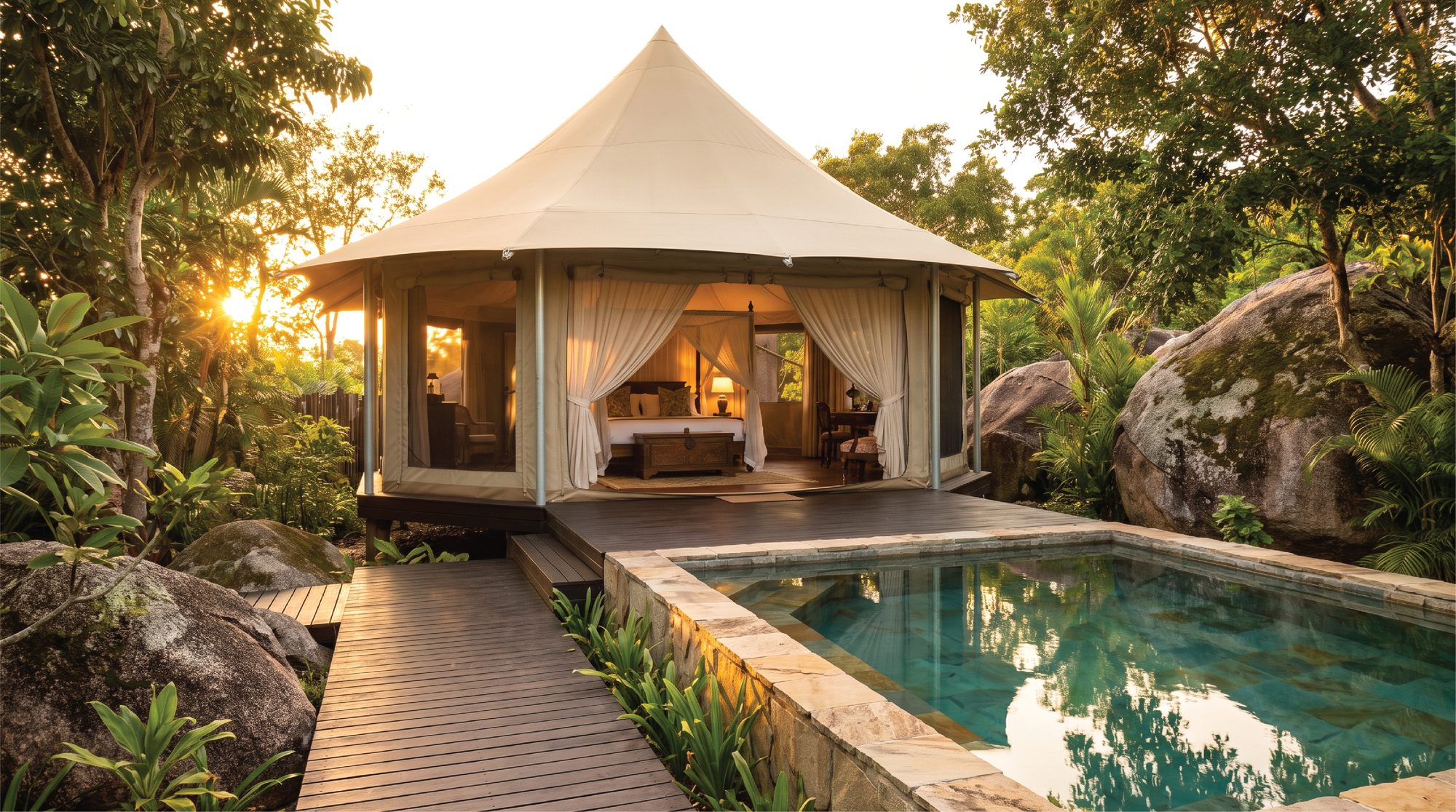
The tents are comfortable, and the camp still feels like the place it stands in.